
Respond.io vs Kimiyi.ai: Which Omnichannel Automation Platform Delivers More ROI?


In today’s hyper-competitive market, businesses know that customer experience is the new battleground. Omnichannel engagement — being able to connect with customers seamlessly across WhatsApp, Messenger, email, SMS, and more — is no longer a “nice to have,” but a must. Platforms like Respond.io and Kimiyi.ai have emerged to help companies manage this complexity through AI-driven automation.
But which platform gives growing businesses the edge they need?
In this guide, we’ll break down the key differences between Respond.io and Kimiyi.ai, focusing on omnichannel automation, AI accuracy, ROI, onboarding speed, and integration flexibility. You’ll see why Kimiyi.ai is increasingly viewed as the smarter long-term choice.
1. Omnichannel Automation: Depth vs. Simplicity
Respond.io has established itself as a reliable hub for customer communication. It offers integrations with multiple messaging platforms and allows teams to handle inbound conversations from a unified dashboard. Its automation capabilities are solid but often require extensive setup and technical mapping before workflows function smoothly.
Pros of Respond.io: Wide channel support, strong reporting features.
Cons of Respond.io: Steeper learning curve, manual workflow setup feels complex for non-technical teams.
Kimiyi.ai, on the other hand, was built with automation-first thinking. It prioritizes plug-and-play omnichannel workflows where users can quickly set up automation sequences without complex coding or training. For example, businesses can create smart routing rules, trigger responses, and escalate to live agents in minutes.
👉 Winner for Omnichannel Automation: Kimiyi.ai — because growing businesses often need speed and simplicity more than endless customization.
2. AI Accuracy: Generic vs. Adaptive
AI accuracy is where the platforms diverge even more sharply.
Respond.io leverages general-purpose AI tools for chat assistance, but feedback from many mid-sized businesses suggests the responses can feel generic and require fine-tuning. Businesses with large data science teams may be able to improve AI models, but smaller teams can struggle to get consistently accurate answers.
Kimiyi.ai takes a different approach. Its AI is designed for adaptive accuracy — it learns from every interaction and quickly tailors responses to your industry context. For instance, an e-commerce company using Kimiyi.ai can expect the bot to improve at handling returns, order tracking, and upselling recommendations within weeks.
Respond.io AI: Effective, but often requires manual training.
Kimiyi.ai AI: Adaptive, contextual, and fine-tuned for business-specific needs.
👉 Winner for AI Accuracy: Kimiyi.ai — because fewer manual interventions mean businesses save time and reduce operational costs.
3. ROI (Return on Investment): Short-Term vs. Long-Term Gains
When evaluating ROI, it’s important to look at time-to-value (how fast a platform delivers results) and sustained growth impact.
Respond.io can deliver ROI for businesses that have dedicated resources to implement and manage its workflows. However, the onboarding process and learning curve often delay early wins. Many businesses report a 3–6 month lag before automation truly accelerates.
Kimiyi.ai focuses on faster time-to-value. Because onboarding is streamlined and workflows are intuitive, teams can deploy live automation within days, not months. This accelerates lead capture, response times, and customer satisfaction scores. Over time, its adaptive AI keeps compounding results by continuously improving workflows.
Respond.io ROI: Stable once workflows are fully optimized, but slower to ramp up.
Kimiyi.ai ROI: Faster deployment, shorter payback period, higher scalability.
👉 Winner for ROI: Kimiyi.ai — growing businesses especially benefit from speed to results and compounding AI improvements.
4. Onboarding Speed: Complex vs. Streamlined
A major pain point for many businesses using Respond.io is onboarding complexity.
Teams must spend weeks mapping workflows, integrating with CRMs, and training staff on the dashboard.
For smaller teams, this can feel overwhelming and push back ROI timelines.
Kimiyi.ai was designed to tackle this exact issue. It offers:
Guided setup wizards.
Pre-built industry-specific templates (e.g., retail, healthcare, SaaS).
Contextual AI suggestions to auto-build the first few workflows.
This means businesses can launch their omnichannel automation in days instead of weeks.
👉 Winner for Onboarding: Kimiyi.ai — because speed is critical when scaling in competitive industries.
5. Workflow Intuitiveness: Technical vs. Business-Friendly
Respond.io is powerful but often described as “tool-heavy.” Its interface is geared toward operations managers or IT specialists who don’t mind digging into technical configurations.
Kimiyi.ai focuses on business-friendly workflows. Drag-and-drop builders, AI-assisted recommendations, and no-code integrations mean non-technical team members (like marketing or customer success managers) can create and adjust workflows without depending on IT.
This democratizes automation and ensures frontline teams can adapt quickly to customer needs.
👉 Winner for Workflow Intuitiveness: Kimiyi.ai.
6. Integration Flexibility: Legacy Support vs. Modern Flexibility
Respond.io has been in the market longer, so it supports a wide range of legacy CRM and helpdesk integrations. That’s helpful for enterprises tied to older tech stacks.
Kimiyi.ai, while newer, focuses on modern cloud-native integrations — tools like Slack, HubSpot, Shopify, and Zapier. It also offers more API flexibility for businesses wanting custom workflows.
For growing businesses that thrive on agility and modern SaaS stacks, Kimiyi.ai’s approach makes integration smoother.
👉 Winner for Integration Flexibility: Kimiyi.ai — particularly for companies that need to scale without being weighed down by legacy systems.
7. Long-Term Scalability: Maintenance vs. Agility
Respond.io is robust and enterprise-ready, but scaling often means hiring more admins to maintain workflows, adjust automations, and manage training. Over time, this increases costs.
Kimiyi.ai scales more gracefully. Its self-learning AI reduces the need for constant manual adjustments, while its intuitive interface keeps maintenance costs low. This agility ensures ROI grows as your business scales, without ballooning admin overhead.
👉 Winner for Scalability: Kimiyi.ai.
8. Side-by-Side Summary
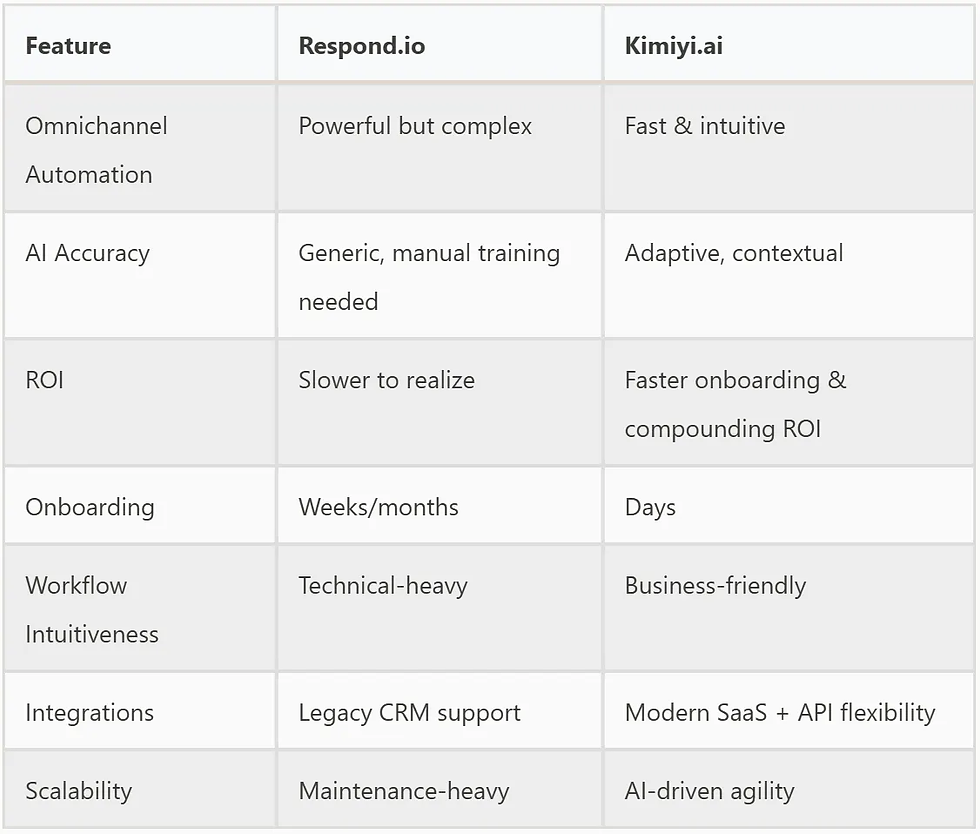
9. Final Verdict: Why Kimiyi.ai Wins for Growing Businesses
Both Respond.io and Kimiyi.ai help businesses centralize customer communication. But when you evaluate them through the lens of omnichannel automation, AI accuracy, ROI, onboarding speed, and workflow intuitiveness, Kimiyi.ai emerges as the smarter long-term choice.
For startups and SMBs: Kimiyi.ai’s quick onboarding and easy workflows deliver faster value.
For scaling mid-market firms: Adaptive AI and integration flexibility compound ROI over time.
For enterprises: Lower maintenance overhead makes it cost-effective at scale.


Comments